Addressing Operational Friction in German Healthcare
Medissist optimizes the clinical workflow by eliminating manual administration, bridging language barriers, and centralizing fragmented patient data into a secure local-first dashboard.
Current Challenges in German Healthcare
Extreme fragmentation and administrative requirements are overloading practice workflows and straining medical professionals.
Non-Uniform Formats
Patient medical history is split across physical scans, handwritten notes, and incompatible software exports. Each format requires time-consuming manual review [1, 2].
Broken or Absent Records
Missing referral letters and inconsistent diagnosis logging force doctors to reconstruct a patient's clinical history from highly fragmented data points [2, 3].
Language & Migration Barriers
With roughly 25% of Germany's population having a migration background, translation needs add significant time to already slowed clinical workflows [2, 4].
How Medissist Helps
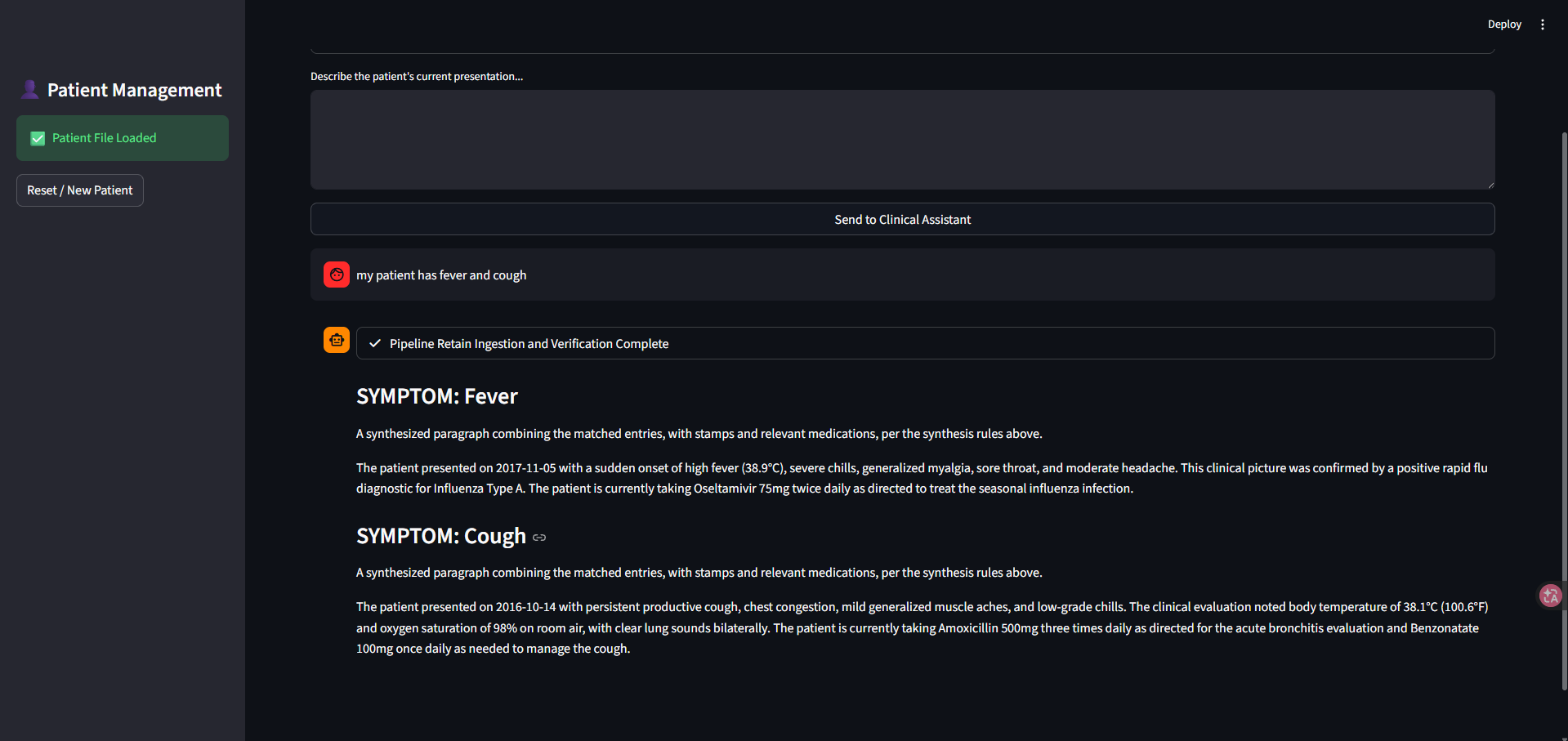
By eliminating manual data reassembly and automating ingestion, Medissist recovers lost clinical time for doctors and staff.
Removes Format Penalty
Scans, structured exports, and free text are ingested into a single searchable record, making history reassembly cost zero extra time.
Bridges Language Barriers
Format- and language-agnostic data ingestion helps reach patients facing language barriers without requiring manual translation delays.
Optimizes MFA Triage
Supports MFAs during initial intake, cutting down chart review time at first contact rather than leaving it entirely to the physician.
Clinical Use Cases
See how Medissist performs in real-world clinic operations.
Managing the "Day One" Sick-Leave Influx
When a patient requests a certificate for a minor illness, their consolidated history surfaces instantly instead of requiring a manual chart review. The doctor can quickly confirm the ailment is minor, rule out underlying complications, and move to the next patient.
Why Current Systems Fall Short & Our Innovation
Traditional cloud-hosted AI models present severe compliance risks regarding patient data privacy and are inherently prone to generating clinical hallucinations. Medissist avoids these systematic flaws entirely by using a purpose-built, highly constrained local security and intelligence architecture.
Bounded Correction, Not Free Generation
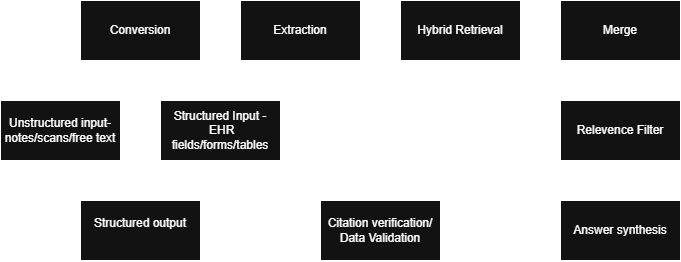
Rather than relying on open-ended autoregressive decoding token generation—which allows models to invent plausible but entirely fabricated medical conditions—Medissist forces a strict deterministic filter over raw transcripts. Imperfect source text and fragmented shorthand are systematically normalized and validated directly against a static, verified clinical vocabulary database. By locking the model's output distribution to verified terminologies, the system structurally eliminates the possibility of fabricating diagnostics, phantom symptoms, or nonexistent pharmaceuticals.
Dual-Mode Retrieval & Two-Tier Reasoning Pipeline
Our closed-loop verification pipeline splits every query into parallel indexing tracks: dense semantic vector search and sparse token-exact keyword matching. Verified internal record fragments must pass an algorithmic relevance threshold and be pulled verbatim before they are introduced into the local context window. Once isolated, a strict two-tier reasoning engine synthesizes the text, explicitly enforcing a rule that any output claim must append a direct, traceable pointer back to the source text fragments, preventing the system from abstracting beyond the provided facts.
Local-Only Inference & Transient Session Memory
To remain fully air-gapped and immune to external vulnerabilities, all neural network inference steps run entirely on on-premise hardware local to the clinical practice. Protected health information (PHI) never leaves the physical boundaries of the site, neutralizing any risks related to third-party data processing or leakage. Furthermore, session states are treated as strictly transient: the temporary context window memory allocations are actively purged and overwritten immediately following the formal conclusion of the patient consultation.
See Our Work in Action
Watch how Medissist handles clinical records and automates patient intake seamlessly.
References & Data Sources
- [1] Analysis of Structural Crises in the German Healthcare System (2026)
- [2] Gutachten 2024 des Sachverständigenrates Gesundheit (SVR)
- [3] Komplexer Versorgungsbedarf in einem fragmentierten Gesundheitssystem (U. Köln)
- [4] Lack of Common Language Obstacles in Healthcare (2020)
- [5] MFA-Mangel: Die unsichtbare Krise in deutschen Arztpraxen (2024)
- [6] MFA-Mangel hat Konsequenzen für die Versorgung (KVHB Bremen)
- [7] Bertelsmann Stiftung: #SmartHealthSystems Comparison
- [9] Abschaffung der Telefon-AU und Krankschreibung ab 1. Tag (Deutsches Ärzteblatt)
- [12] Hausärzte beurteilen Reformplan als „absolut katastrophal” (FOCUS online 2026)
- [13] Vertragsärzte rechnen mit 30M zusätzlichen Besuchen (Deutsches Ärzteblatt)
- [14] Bürokratie in der Arztpraxis (Nixi AI)
Apply for the Medissist Pilot Program
We are currently accepting a limited number of medical practices and Hausarzt clinics in Germany to participate in our early access deployment program.
Application Submitted Successfully!
Vielen Dank. Our clinical onboarding team will review your practice requirements and get back to you within 2 business days.
Contact Medissist
Have questions about local hardware deployment, GDPR compliance, or custom EHR integration? Reach out to our Munich-based support team.
Headquarters
Medissist Health Technologies
Richard-Wagner-Straße 28/B, 86343 Königsbrunn, Germany
Email Enquiries
General Info: [email protected]
Pilot
Support: [email protected]
Hotline & Urgent Support
Phone: +49 (0) 176 670-99839
Mon - Fri: 09:00 - 17:00 CET